


Eevie Darke
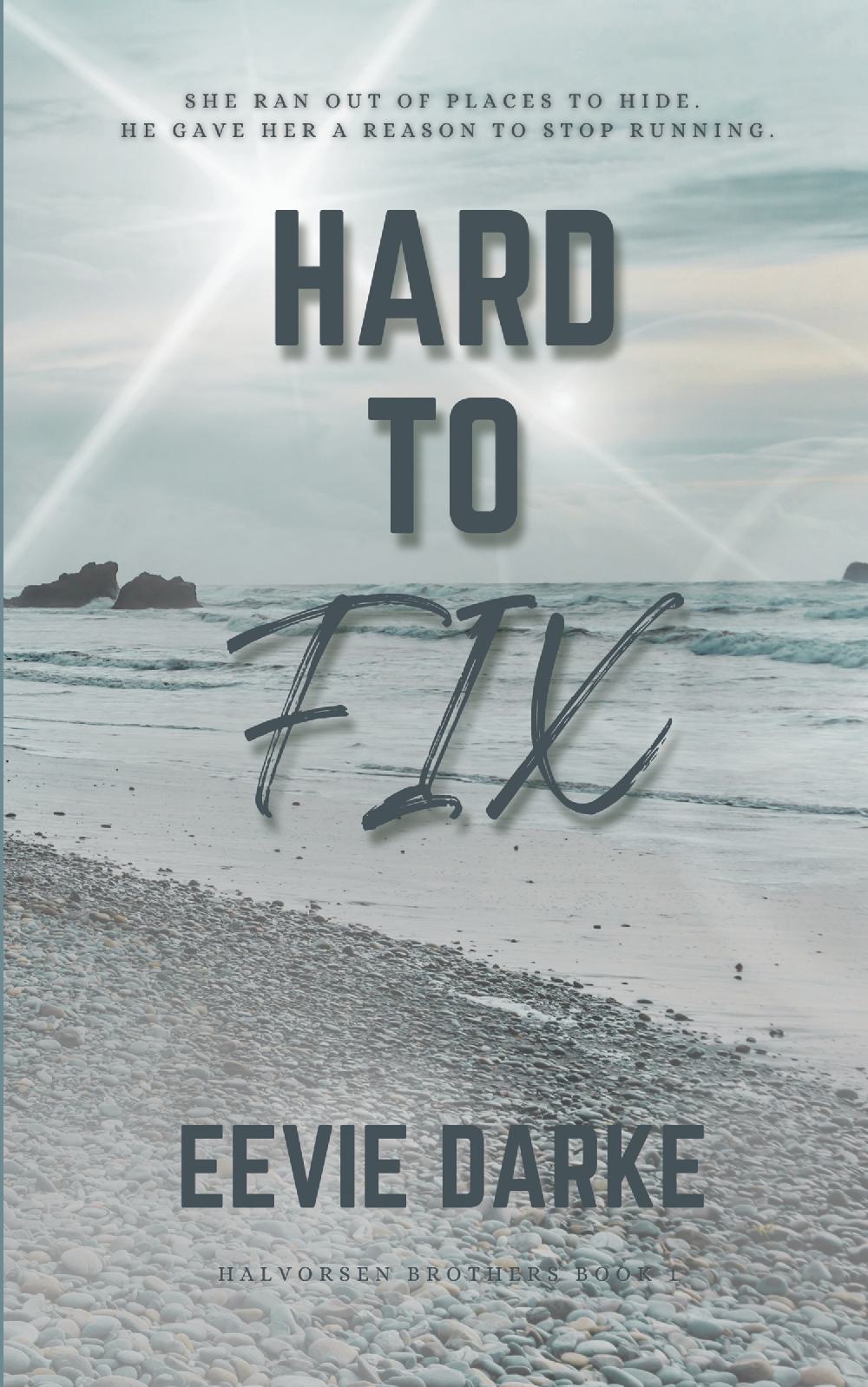
Hard to Fix (Paperback)
Hard to Fix (Paperback)
Couldn't load pickup availability
- Grumpy mechanic × single mom on the run — slow-burn small-town romance
- Halvorsen Brothers · Book 1 — reads as a standalone
- Signed-paperback option · printed to order, ships worldwide
- Slow burn → steamy · found family · guaranteed HEA · content notes inside
She was looking for her way back home. He didn't realize he had exactly what she needed.
Dean Halvorsen doesn't talk much. Doesn't smile much. But he remembers me, the girl who left, and something in his quiet, steady presence makes the ground feel solid for the first time in years. He fixes my car without being asked. Pours my coffee the way I like it before I've said a word. Shows up at my trailer door with groceries he claims were "extra."
I know what he's doing. I know what it means. And I know I should stop letting him in before my past comes crashing through everything he's trying to build.
Because the man I ran from doesn't forgive. He doesn't forget. And Salt Point might not be far enough.
But Dean? Dean doesn't run.
What you're in for
- Grump/sunshine
- Slow burn
- He falls first
- Single mom
- Protective Hero
- Acts of Service
- Found family
The details
| Pages | 392 |
|---|---|
| Series | Halvorsen Brothers |
About Eevie
Eevie Darke writes slow-burn small-town romance about gruff, guarded men and the women who finally get them to let someone in. Expect found family, fierce protectiveness, acts of service as a love language, and a hard-won happily-ever-after every single time.
How your book gets to you
Your copy doesn't sit in a warehouse. It gets printed just for you when you order — that takes a few days, usually 3–5 business days before it ships. Then it's on its way to you, anywhere in the world, with tracking in your inbox the moment it leaves the printer.
Adding a signed book plate? That ships separately from my desk here in the PNW — it usually beats the book to your door.
Share


Read the first chapter
Chapter One · Dean
The Rusty Anchor smells the way it always has—stale hops and decades of spilled whiskey soaked into the floorboards. I sit with my back to the wall, nursing the same beer I’ve been working on for twenty minutes, while my brothers fill the silence I’ve left at our corner table. Outside, the rain taps against windows filmed with salt spray, a steady rhythm that makes more sense to me than whatever Logan’s saying about the coming tourist season.
“Mark my words,” Logan says, tapping the scarred tabletop with enthusiasm. “Cedar Hollow overflow is gonna hit us hard this summer. All those rich bastards with their boats need somewhere to go when their marina fills up.”
I take another sip of lukewarm beer. I watch as Logan leans back, arms draped over the empty chair beside him. His long dark blonde hair falling into his blue eyes. He’s wearing worn flannel and jeans like the rest of us, but he’s somehow cooler than the rest of us. Which explains why he’s so popular with the ladies.
Eli doesn’t look up from his phone. “That’s what you said last year.”
“And the year before,” Caleb adds, his massive frame making the wooden chair beneath him look like dollhouse furniture. “Think they still got that billboard up saying ‘Don’t Stop in Salt Point’?”
“It says ‘Last Services 15 Miles,’” Logan corrects, running a hand through his hair in an attempt to get it out of his face. It just falls right back in his eyes when he’s done. He really should cut it. “Same meaning, less lawsuit potential.”
I scan the door again. It’s habit more than expectation. Sawyer’s not coming. Never said he would. He’s the youngest of us still in town and probably has better things to do on a Friday night than hang out with all of his older brothers. I switch to peeling the label off my beer bottle, focusing on getting it off in one piece like it matters.
The Anchor’s half-empty tonight—only the usual suspects. Old Pete Henderson nursing whiskey at the bar, knuckles rough and knobbled from his crab traps. The Richardson twins, Ronnie and Theo, playing pool and arguing over the same girl, Penny Johnson, they’ve fought over since tenth grade. The bartender—Terry’s kid, can’t recall his name—wiping down the counter with a rag that’s probably adding more grime than it’s removing.
“You in there, Dean?” Logan waves a hand in front of my face.
I grunt, which counts as participation in my family.
“I said, we could expand the salvage yard toward the old cannery road if we get Cedar Hollow overflow. Tourist accidents are good for parts.”
“Tourist accidents aren’t funny,” Eli mutters, frowning at his phone.
“Wasn’t being funny,” Logan says, but his smile betrays him. “Being opportunistic.”
The neon Rainier sign above the bar flickers, casting uneven light across their faces, hiding and revealing the years etched into them. The lights play off Caleb’s fairer hair—he’s the fairest of us all. Almost the opposite to my brown. Fitting.
I roll my glass between my palms, feeling the cold sweat of condensation. “Garage is fine as it is.”
Logan shakes his head. “Always forward-thinking, Dean. That’s what I admire about you.”
He doesn’t mean it as a cut, but it lands like one anyway. I let the silence answer for me.
“Heard something interesting from Missy today,” Caleb says after a beat too long, changing the subject with all the subtlety of a breaking transmission. “You remember Mari Hart? She’s back in town.”
I stare at him blankly. The name should mean something, but it doesn’t. Or maybe it does, but too far back, buried under years of engine grease and minding my own business.
“Mari,” Caleb repeats, like saying it louder will help. “Skinny girl, dark hair. Was in Sawyer’s class.”
“Wasn’t she the one who used to bike past the garage every day after school?” Eli looks up from his phone, suddenly present. “The rusty Schwinn with the basket?”
Something flickers in the back of my mind. A girl on a bike. Summer heat. The smell of hot metal and sunbaked asphalt. But a girl in Sawyer’s class makes her a good eight years younger than me.
“That’s her,” Caleb nods. “Missy says she’s got a kid with her now. Little boy, maybe four or five.”
My hand pauses on my glass, for a second. Something about hearing that someone from Salt Point not only left but came back never sits right with me. I wouldn’t wish this place on my worse enemy.
“Wonder what brought her back,” Caleb says, glancing my way like he expects me to have an opinion.
I shrug, taking another pull from my beer. The condensation runs down my wrist.
“Maybe she missed the weather,” Logan says dryly as rain pelts harder against the window. “Or our sparkling local economy.”
“Maybe something went wrong wherever she was,” Eli suggests, his tone shifting to something softer. “Not everyone leaves because they hate it here.”
“Bullshit,” Logan snorts. “That’s exactly why people leave.”
Caleb runs a thumb along the rim of his glass. “Missy says she’s staying in that trailer park by the old mill.”
“Jesus,” Logan winces. “That’s not much of a homecoming.”
I watch a drop of water slide down my beer glass, leaving a trail like a tear. The conversation continues around me, theories and speculation filling the air, but my thoughts drift. A girl on a bike. A trailer park. A child without a father mentioned.
“Dean?” Caleb’s voice breaks through. “You good?”
I realize I’ve been staring at nothing, the label I peeled off my beer bottle shredded into confetti on the table in front of me. I nod, once, definitive.
“Yeah,” I say. “I’m good.”
“Speaking of,” Eli says, pocketing his phone, “did you get that system up and running yet?” He doesn’t specify which system. Doesn’t have to. We both know he’s talking about the computer setup he insisted on installing at the garage last month—a gleaming intruder in my office.
I grunt, the universal Halvorsen response for questions we don’t want to answer. My jaw tightens, the way it does whenever someone mentions the damn computer. My shoulders rise half an inch, armor against the inevitable lecture.
“That a yes or a no?” Logan asks, signaling the bartender for another round.
“It’s there,” I say, after a long pause. “It’s on. I think.”
Eli sighs. “Being on and being used are different things, Dean.”
Behind the bar, the TV flickers through sports highlights nobody’s watching. I focus on that instead of my brother’s disappointed face. Three weeks ago, I let Eli set up a computer system at the garage because he wouldn’t stop talking about inventory management and digital invoicing and how I’m “losing money with paper ledgers, Dean, it’s not 1992 anymore.” Easier to say yes than explain why some things don’t need fixing.
“You know,” Eli continues, leaning forward, elbows on the table, “that system can track every part you’ve got. Tell you what’s moving, what’s not. Generate reports on seasonal trends.”
Eli might as well have landed an alien spaceship on my office desk. He even taped my password up on the wall next to the monitor, as if my remembering the password was the main obstacle to its use.
“And invoicing,” Eli’s going now, hands excitedly gesticulating, “it’ll email customers automatically. Track who’s paid, who hasn’t. No more hunting through that shoebox of receipts.”
I take another pull from my beer. The shoebox system has worked fine for fifteen years. Dad used it. Grandad used something similar. Salt Point doesn’t change, so why should Halvorsen’s Auto & Salvage?
A burst of laughter from the pool table cuts through the bar. The Richardson twins are shoving each other now, their eternal argument escalating the way it always does around drink four. I find myself cataloging what will break if they start throwing punches—the dartboard with the missing third of its face, the Rainier sign with its loose mounting, the row of dusty bottles nobody ever orders from.
“...which would increase efficiency by at least thirty percent,” Eli is saying when I tune back in.
“He’s not listening,” Caleb says, his voice rumbling with amusement. “Look at his face.”
Logan snorts. “Classic Dean. Ask him about a carburetor and he’ll talk your ear off. Mention software and he checks out faster than a Cedar Hollow tourist after seeing our beaches.”
“The beaches are fine,” I mutter, because that’s easier to defend than my aversion to computers.
“It’s literally called Rust Bay,” Logan counters. “There’s actual tetanus in the sand.”
“It’s your auto shop, Dean,” Eli says, steering us back. “You’re the one who has to use the system.”
“I know that.” My voice comes out sharper than intended. The table goes quiet.
The truth sits heavy between us. It’s my shop because I’m the only one who stayed. Because Logan chose firefighting, Eli chose tech, Caleb chose carpentry, Sawyer chose fishing, and Mason... well, whatever Mason chose, it wasn’t Salt Point. I stayed with the garage because someone had to. Because it’s what was left.
“Just trying to help,” Eli says after a moment, making me feel like I kicked something small and defenseless.
I exhale, running a hand through my hair that needs a cut I’ll put off for another month. “I know. I’ll figure it out.”
“How the hell do you deal with any cars manufactured after 2005, man?” Logan laughs. “You know, anything with a fucking computer in it?”
“Probably duct tape,” Caleb chimes in.
“Maybe he just doesn’t take off the shrink wrap,” Logan jabs. “Keeps ’em nice and new.”
“Ever heard of a diagnostic assembly line?” Eli smirks, picking up on the bit. “Because Dean hasn’t.”
“Power train module.”
“CD player.”
“Bluetooth.”
Maybe they’re just fucking with me, or maybe they’re tired of me being a pain in the ass about the computer. Caleb raises his glass as they go on.
“Can you even fix a power window?” he asks, and Logan laughs so hard he almost drops his drink.
Even Eli’s in on it—hiding a smile behind his raised beer. I grit my teeth against everything I want to say. Telling them to back off would just make it worse.
“I need instructions on how to install air fresheners,” I deadpan, letting my sarcasm cut through.
Of course, they take it as permission to keep going.
“Should we tell him about hybrids?”
“Do you think he knows?”
“What about those new electric cars?”
“Battery-powered? Like his computer?”
I run a hand over my face but can’t help the twitch of a smile. The humor wears a little thin in places, but it’s there.
“It’s called Halvorsen’s Auto, not NASA,” I say, taking refuge in my lukewarm beer. “I’ll deal.”
They’re still laughing.
“It’s not 1992 anymore, Dean!” Logan’s gasping for breath.
The computer’s one more thing I don’t want to fuck up. Feels like it’s too late for that.
Thankfully, the bartender brings our next round, and Logan changes the subject to the Mariners’ losing streak, neutral territory that doesn’t require me to think about change or computers or girls returning to town with kids in tow. I let the conversation flow around me, nodding when it seems right, making the minimum effort to participate.
Caleb drains his beer, setting it down with a decisive thunk. “Think I’m gonna head out. Got an early job at the Wilsons’ place tomorrow.”
“Building them a deck?” Logan asks.
“Rebuilding,” Caleb corrects. “Apparently the last guy used only nails. You know, fine for some things … but religiously against screws. Fuck if I know. Whole thing’s separating from the house. No support, I mean it can stand for comedic purposes only.”
“Amateurs,” I mutter, and Caleb nods, a moment of solidarity in craftsmanship that bridges our differences.
We finish our beers in comfortable silence, the kind that comes from spending so many years saying nothing together that the nothing becomes something. Logan throws down cash for the round—always the generous one, even on a firefighter’s salary. Eli checks his phone one last time. Caleb stretches, his shoulders popping like kindling.
“Same time next week?” Logan asks as we stand, the ritual question that keeps us tethered to each other.
I nod, already calculating the hours between now and then, the cars waiting at the garage, the invoices—paper ones—piling up, the parts needing ordering. The routine that keeps Salt Point’s engine running, even as the town rusts around us.
Outside, the rain has stopped, but the air hangs heavy with the promise of more. Water drips from the Anchor’s gutters in an irregular beat. Down the street, the lights of the marina pulse weakly through the fog. Another Friday night in Salt Point.
“Don’t forget to enter those invoices,” Eli calls over his shoulder as we part ways in the parking lot.
I raise a hand in acknowledgment but don’t promise anything. Some changes come slowly, if they come at all. Like rust on a car body, like erosion on the cliffs, like the gradual realization that a name from the past—Mari Hart—might mean something after all.
Keep reading — the paperback’s at the top of this page.